The Internet Coup
A Technical Analysis on How a Chinese Company is Exporting The Great Firewall to Autocratic Regimes
September 09th, 2025
Read the full report The Internet Coup: A Technical Analysis on How a Chinese Company is Exporting The Great Firewall to Autocratic Regimes.
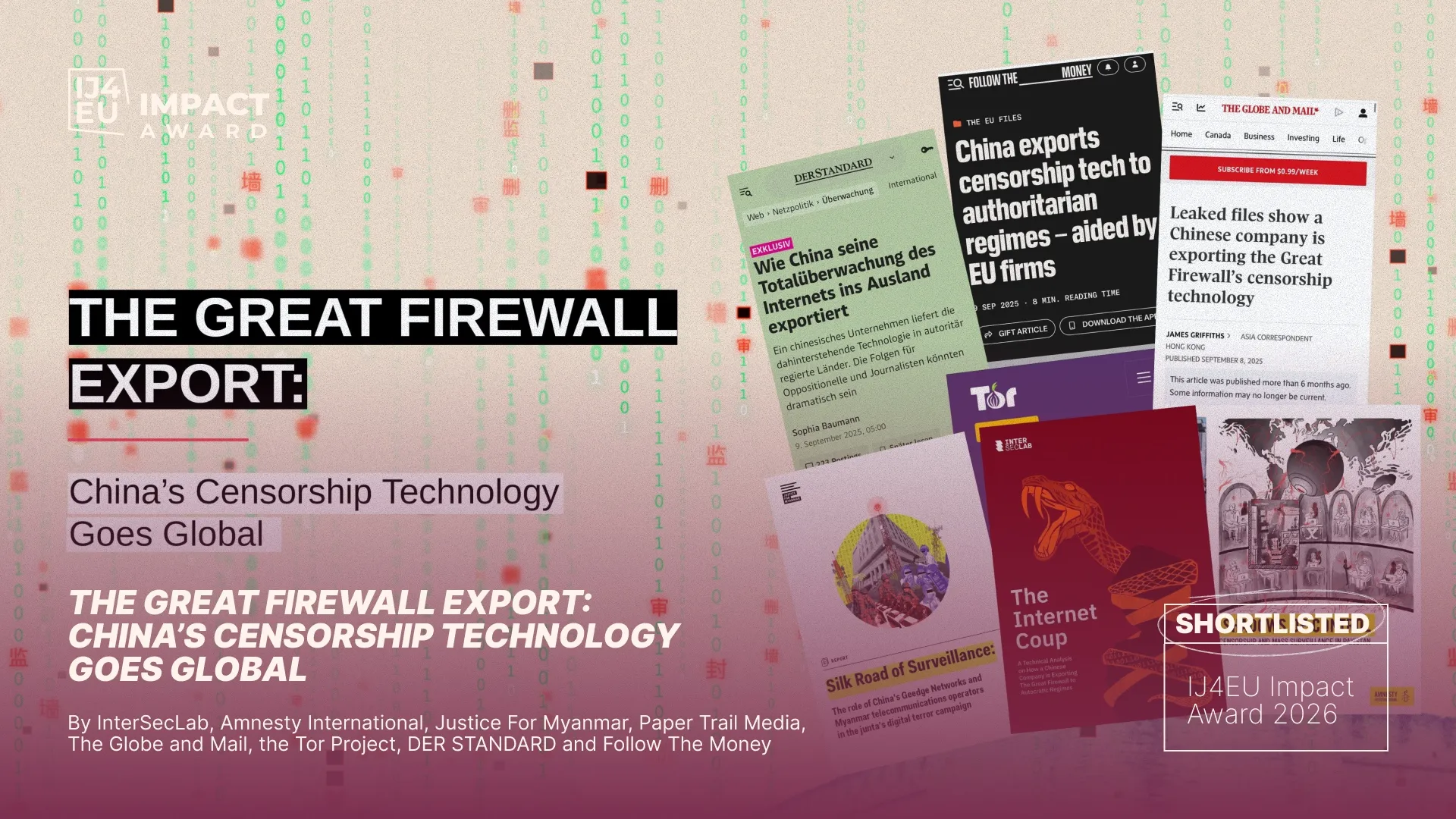
This research by InterSecLab is part of the Great Firewall Export investigation, a joint collaboration with the partners Amnesty International, Justice For Myanmar, Paper Trail Media, The Globe and Mail, the Tor Project, the Austrian newspaper DER STANDARD and Follow The Money.
Summary
Over the past two decades, the Chinese government has been steadily refining their model of internet control using surveillance and censorship technologies domestically while promoting this approach to other nations under the banner of “digital sovereignty”. Through the export of these technologies, China is not only extending its global influence but also laying the foundation for a federated system of internet governance. In this system, Chinese companies provide the infrastructure and expertise for client governments to more easily monitor and control their own networks, while learning from these deployments and improving collective capacity for digital authoritarianism worldwide.
This research by InterSecLab uncovers evidence of the export of a suite of technologies resembling China’s Great Firewall by Geedge Networks, a private company linked to the academic entity ‘Massive and Effective Stream Analysis’ (Mesalab), a research laboratory at the Chinese Academy of Sciences. Our team’s investigation identifies a pattern of commercialization of surveillance capabilities, with Geedge Networks offering a suite of products that enable comprehensive monitoring and control of internet users.
InterSecLab’s analysis reveals that Geedge Networks is contracted with governments in Kazakhstan, Ethiopia, Pakistan, Myanmar, and one other unknown country to establish sophisticated systems of internet censorship and surveillance. Furthermore, our findings indicate that Geedge Networks is also involved in developing similar systems deployed within China, including in Xinjiang and other regions.
Based on analysis of a leak of more than 100,000 Geedge Networks documents that was shared with InterSecLab, this research sheds light on the features and capabilities of Geedge Networks’ systems, which include deep packet inspection, real-time monitoring of mobile subscribers, granular control over internet traffic, as well as censorship rules that can be tailored to each region. The leak also reveals information about Geedge Networks’ relationship with the academic entity, Mesalab, as well as their interactions with client governments. The implications for data sovereignty are significant, and our findings raise concerns about the commoditization of surveillance and information control technologies.
This research examines the recent development of Geedge Networks’ systems in various countries, including what is known about their deployment timelines. By analyzing the company’s internal documentation, InterSecLab was able to chronicle the expansion of commercially available national firewalls and speculate about the implications for the future of the global internet considering the spread of such systems.
Read the full report The Internet Coup: A Technical Analysis on How a Chinese Company is Exporting The Great Firewall to Autocratic Regimes.
Key findings
Mass export of China’s ‘Great Firewall’ model
Geedge Networks’ offerings enable comprehensive surveillance and censorship capabilities.
Regionalizing the Great Firewall within China
We identified regional Chinese provincial firewall projects in Xinjiang, Fujian, and Jiangsu.
Identifying VPNs and circumvention tools
Geedge Networks’ government clients are able to look back at an internet user’s past activities to see if they have used a VPN or circumvention tool before it was blocked.
Expanding digital authoritarianism through regular OS updates
Clients are able to request features and capabilities for Geedge Networks to prioritize for new versions of the surveillance software. When they make these software updates available, every client government can take advantage of these new capabilities.
No built-in legal or ethical guardrails on sharing and use of data
Designed for interoperability with commercial hardware vendors, making targeted sanctions more challenging.
Significant implications for data sovereignty
Internet user data from each country appears to be accessible to Geedge Networks employees and shared with students at Mesalab.
Internationally-funded ISPs are implicated
Geedge Networks works with Internet Service Providers (ISPs) directly to install their products. Government workers access the data remotely from a command-and-control center.
Copying and building on existing commercial products and open source code
What Geedge Networks’ tools can do
- Deep packet inspection for intercepting and manipulating user traffic
- Real-time location tracking of mobile subscribers
- Network traffic analysis during protests and events
- Automated flagging of “suspicious” user traffic patterns
- Customized website and application blocking
- Traffic throttling to specific services
- Individual user identification and tracking, including VPN users
- Reputation scoring systems based on online behavior
- Malware injection capabilities
The implications of these findings are profound: the commoditization of surveillance technologies creates an existential threat to democratic societies worldwide.
Translation

網路政變 - InterSecLab
Translated into Traditional Chinese by Anonymity Networks Community
The Great Firewall Export investigation

Shadows of Control: Censorship and mass surveillance in Pakistan
Amnesty International

China exports censorship tech to authoritarian regimes
Follow the Money
Interviews
Academic Mentions

Geedge Cases: Censorship Measurement Insights from the Geedge Networks Leak
Authors: Jade Sheffey (University of Massachusetts Amherst), Ali Zohaib (University of Massachusetts Amherst), Mingshi Wu (GFW Report), Amir Houmansadr (University of Massachusetts Amherst)

The Game Has Changed: Revisiting proxy distribution and game theory
Authors: Hassan Fares (University of Minnesota), Omkar Fulsundar (University of Minnesota), Nicholas Hopper (University of Minnesota)
Shortlisted for IJ4EU Impact Awards 2026

The Great Firewall Export: China’s Censorship Technology Goes Global
By InterSecLab, Amnesty International, Justice For Myanmar, Paper Trail Media, The Globe and Mail, The Tor Project, Der Standard, and Follow The Money